How to Choose a Thai Massage School — 7 Checks
A practical checklist before you pay any Thai massage school — school licence, accredited curriculum, hour count, bilingual certificate and job support.
Short answer
Check seven things before paying any massage school in Thailand — (1) the school holds a Ministry of Education establishment licence, (2) the curriculum is accredited by the Ministry of Public Health, (3) a 150-hour course is offered, (4) certificates are bilingual Thai–English, (5) class size is no more than 8–12 students per instructor, (6) you practise on real clients before graduating, and (7) job referral is offered after you finish.
Every month someone walks into our school holding a certificate from somewhere else and says: "I already trained, but they told me this certificate cannot be used." Tens of thousands of baht and several weeks, gone — because of a decision made before the first class.
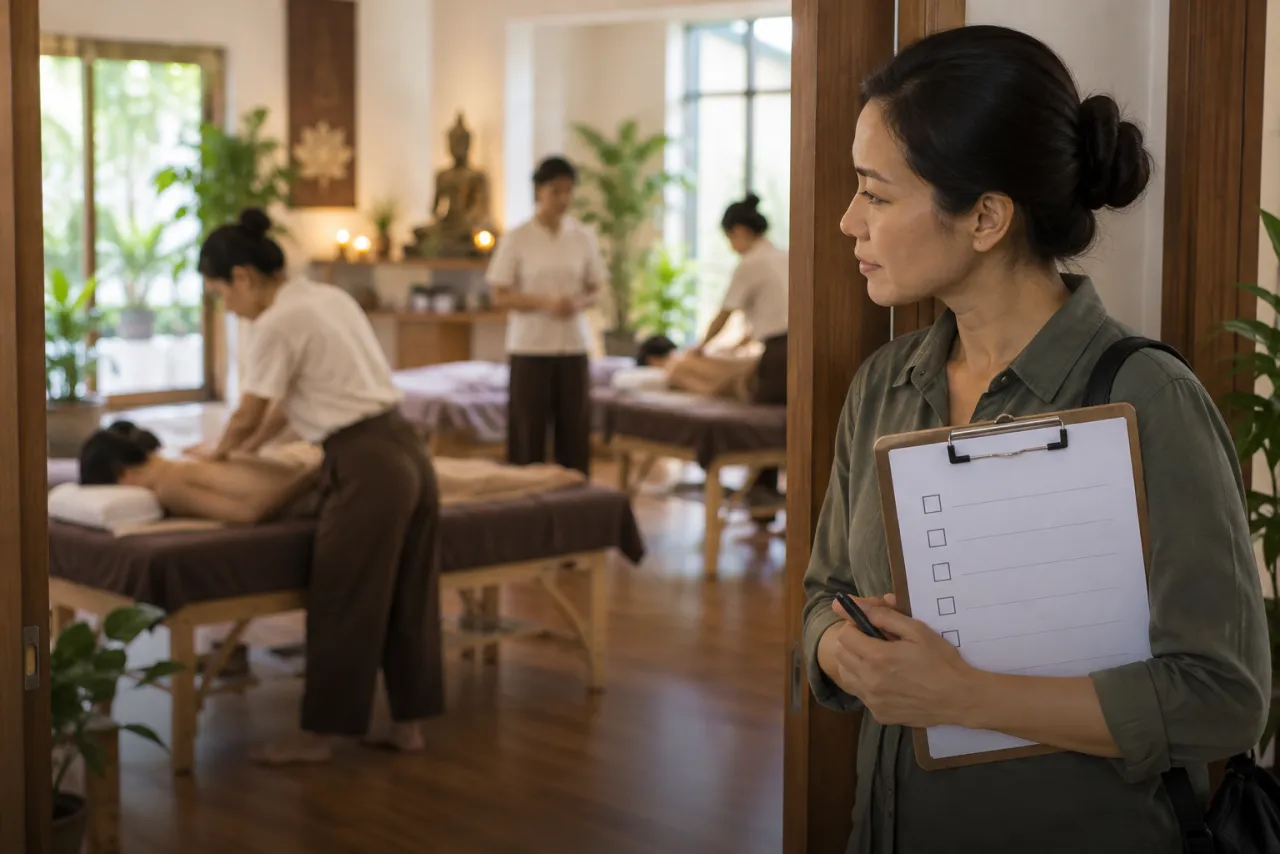
Here is the checklist to run before you transfer money to any school, including ours.
1. Does the school hold a Ministry of Education establishment licence?
This is the first question, and the one almost nobody asks.
A "school" and a "training centre" are not the same thing legally. A licensed school has a licence number, and the certificates it issues carry weight when you file documents later.
How to check: ask to see a copy of the establishment licence. If a school avoids the question, treat that as a warning.
2. Is the curriculum accredited by the Ministry of Public Health?
A school licence is one thing. Accreditation of the curriculum is another.
A health massage curriculum must be accredited by the Department of Health Service Support before its certificate can be used for practitioner registration. Some institutions hold a school licence but an unaccredited curriculum — and the certificate still cannot be registered.
3. Is a 150-hour course available?
150 is the magic number in this industry.
The Department of Health Service Support requires at least 150 contact hours for health massage practitioner registration. Courses of 30, 60 or 100 hours can be used to apply for jobs, but not to register.
If your goal is legal long-term work, or work abroad, you need at least 150 hours.
4. Is the certificate bilingual?
People rarely think about this when choosing, and often regret it later.
If you ever want to work in a foreign-owned hotel spa, on a cruise ship, or overseas, employers and embassies will ask for an English certificate. A Thai-only certificate means paying for translation and legalisation — sometimes more than the tuition itself.
5. How many students per instructor?
Massage is learned by having your hands corrected, not by watching.
With thirty students and one instructor, you will be reached perhaps twice a day. That means practising the wrong technique all day with nobody telling you — and once a bad habit sets, it is very hard to remove.
The workable ratio is no more than 8–12 students per instructor.
6. Do you practise on real clients?
Massaging a classmate of similar age, similar build, with no complaints, does not prepare you for real work.
Real clients are sixty with worn knees. They are heavy and hard to compress. They ask "can you go harder?" And some flinch every time you touch them.
A good school arranges supervised practice on real clients before you graduate.
7. What happens after you finish?
The last and most important question.
What should be included:
- Job referral that genuinely works and does not expire
- Re-study rights, because skills fade when unused
- Help preparing registration documents, not being left to work it out alone
- A channel to ask questions later, when you meet a difficult case at work
A school that cuts contact the moment you graduate is selling certificates, not careers.
The checklist in one table
| # | What to verify | Why it matters |
|---|---|---|
| 1 | Ministry of Education establishment licence | Gives the certificate legal weight |
| 2 | Ministry of Public Health curriculum accreditation | Makes registration possible |
| 3 | 150-hour course offered | The minimum for registration |
| 4 | Bilingual certificate | Lets you work abroad |
| 5 | Max 1:12 instructor ratio | You actually get corrected |
| 6 | Practice on real clients | Ready to work on day one |
| 7 | Support after graduation | A career, not just a document |
Does Michael Thai Massage School pass all seven?
It does — and we invite you to verify every point before deciding. Ask to see the licence, ask to see a sample certificate, ask to speak to a graduate, or come and watch a class in person.
Because if you choose us and it turns out not to fit, that means we advised you badly in the first place.
See the Thai massage 150-hour course, or read the full guide to practitioner registration before you decide.
Frequently asked questions
Which massage certificates can actually be used for registration?
What is a reasonable price for a 150-hour course?
Can an online massage course be used for registration?
Related courses
- Thai Massage for Health — 150 HoursTuition 4,900 THB
- Foot Reflexology for Health — 60 HoursTuition 4,900 THB
Related searches
Serious about starting? Talk to us first.
Free LINE consultation