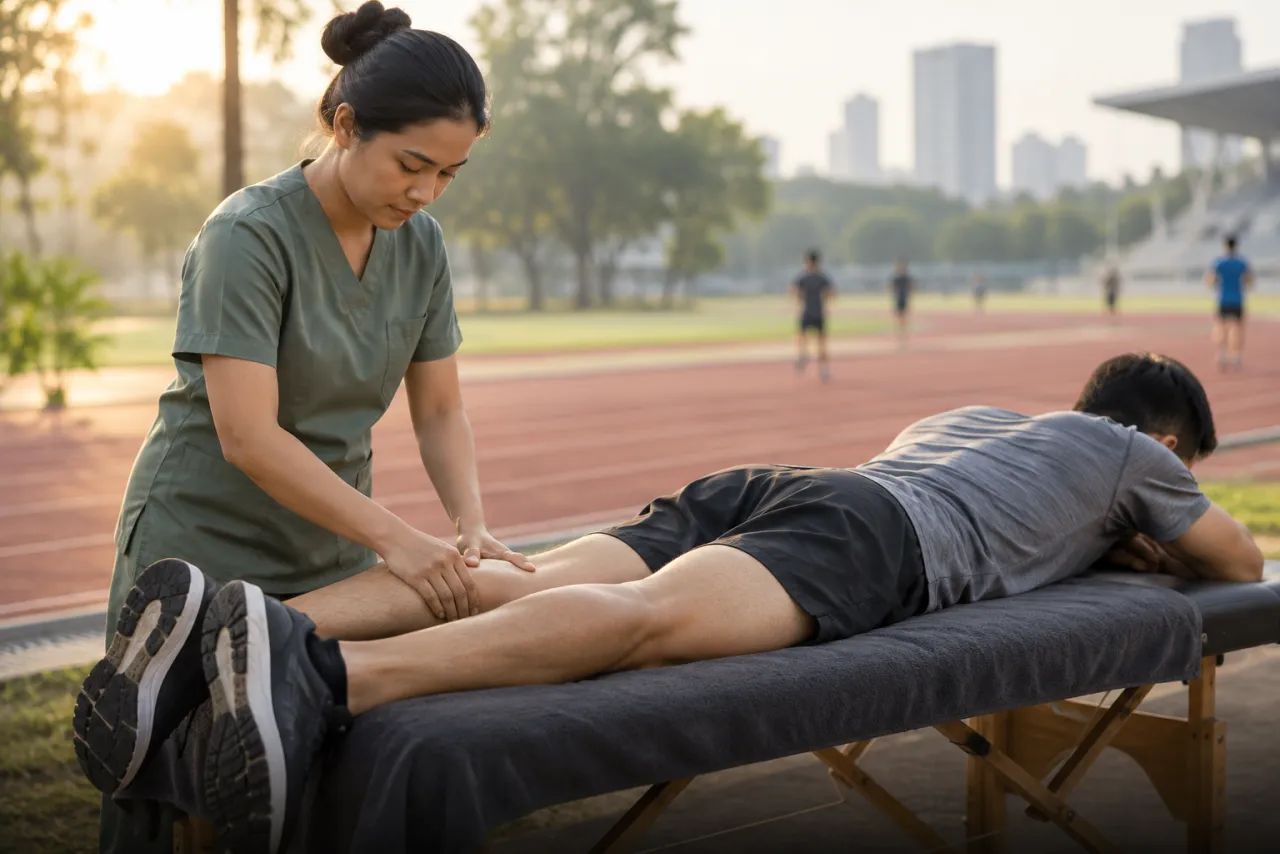
Working as a Thai Massage Therapist Abroad
Documents, experience and preparation to work as a Thai massage therapist overseas — bilingual certificate, practitioner registration and realistic pay.

Short answer
Working as a massage therapist abroad requires at least four things — a bilingual Thai–English certificate from an accredited school, a course of 150 hours or more, Thai health massage practitioner registration (SorPorSor.14), and six to twelve months of real working experience. Basic conversational English with clients is also expected by most employers.
Thai massage is one of the few skills where the global market genuinely wants Thai practitioners, and pays several times the domestic rate.
But before you go, the paperwork has to be complete.
The four essentials
1. A bilingual certificate
This is where people are caught out most often.
Foreign employers and embassies do not read Thai. If your certificate is Thai-only, you will pay for translation and legalisation — sometimes more than the tuition cost, and taking weeks.
Choose a school that issues bilingual certificates from the start.
2. A course of 150 hours or more
Many countries set a minimum contact-hour requirement for massage providers, and 150 hours is widely accepted.
Some destinations require more — 300 or 500 hours — in which case you may need to combine several courses.
3. Practitioner registration (SorPorSor.14)
This shows you have been vetted by a Thai government authority. It supports work visa applications and gives employers confidence.
See the full guide on the licensing page.
4. Six to twelve months of real experience
Almost every overseas employer asks for a work history. Nobody hires someone who has just finished a course and never taken a paying client.
Those first months in Thailand are not wasted time — they are your résumé.
Popular destinations
| Destination | Type of work | Approximate pay |
|---|---|---|
| Cruise ships | Onboard spa, 6–9 month contracts | 80,000–150,000 THB/month |
| Middle East (UAE, Qatar) | Five-star hotel spas | 70,000–130,000 THB/month |
| Europe (Switzerland, Germany) | Spas and therapy clinics | 100,000–180,000 THB/month |
| Japan, Korea | Thai massage shops and spas | 70,000–120,000 THB/month |
| Australia, New Zealand | Clinics and spas | 90,000–150,000 THB/month |
Figures are indicative and vary widely with contract terms, accommodation and cost of living.
Look past the headline salary. Check whether accommodation, meals, flights and health insurance are included — some lower-paying contracts leave you with more savings.
A route that actually works
- Complete Thai massage 150 hours with a bilingual certificate
- Register under SorPorSor.14 immediately after graduating — do not delay
- Work in Thailand for 6–12 months, ideally somewhere with international clients so you practise English at the same time
- Add oil massage 150 hours, since international spas are oil-based
- Prepare an English CV with copies of your certificate and registration
- Apply through verifiable channels — hotel or cruise company websites directly, or properly licensed agencies
What to watch out for
Never pay a large fee to an agent before you have a contract — this is the most common scam.
Never travel on a tourist visa intending to work — it is illegal everywhere. If caught you will be deported and blacklisted.
Read the whole contract before signing — especially daily hours, days off, overtime, and termination terms.
Verify the employer exists — search the hotel or spa name, read reviews, check the address. If you find nothing at all, be suspicious.
Start with the Thai massage 150-hour course, which issues a bilingual certificate, then add oil massage 150 hours — the technique international spas want most.
Frequently asked questions
How good does my English need to be?
Am I too old to work abroad?
How do I avoid recruitment scams?
Related courses
- Thai Massage for Health — 150 HoursTuition 4,900 THB
- Aromatherapy Oil Massage for Health — 150 HoursTuition 4,900 THB
Related searches
Serious about starting? Talk to us first.
Free LINE consultation